Why Focusing on One Area While Neglecting Others Keeps You Stuck
Three women in my What’s Next Circle said almost the same thing within a single month of each other. Different words, same ache: “I’m doing everything right and still feel like something’s missing.”
The first — a retired hospital administrator — was walking four miles every morning and tracking her sleep. Her vitality markers were excellent. But she had made nothing with her hands in eleven years. Nothing creative.
The second had a full social calendar: book club, grandchildren, lunch with friends. Surrounded by people who cared about her. But when I asked what she was working toward — what was hers, just hers — she went quiet. “I don’t actually know,” she said.
The third was volunteering three days a week and serving on two community boards. She generously showed up everywhere she was needed. To everyone except herself.
All three were doing things. Good things. Real things. And all three felt the same low-grade emptiness they couldn’t quite explain. Because a fulfilling life isn’t about doing more. It’s about doing enough in each domain that matters.
Why One Domain Is Never Enough
Here’s what longevity researchers have been confirming for decades: the people who live longest and best — with vitality, clarity, and genuine joy well into their 80s and 90s — aren’t just healthy. They’re not just connected or purposeful. They’re all of those things, tended simultaneously.
The Blue Zone research — the study of the world’s longest-lived communities — found that people thriving at 90 weren’t doing one thing magnificently. They had movement, belonging, purpose, and rest. Not perfectly, but all of it present. Brené Brown’s research confirms that real belonging is one of the most powerful predictors of well-being. Longevity researcher Peter Attia argues emotional health is as critical as any physical metric. The pattern is consistent: a life richly lived in only one or two dimensions will eventually feel thin, no matter how well you’re executing those dimensions.
Neglecting your own domains doesn’t make you more available to others. It makes you more depleted.
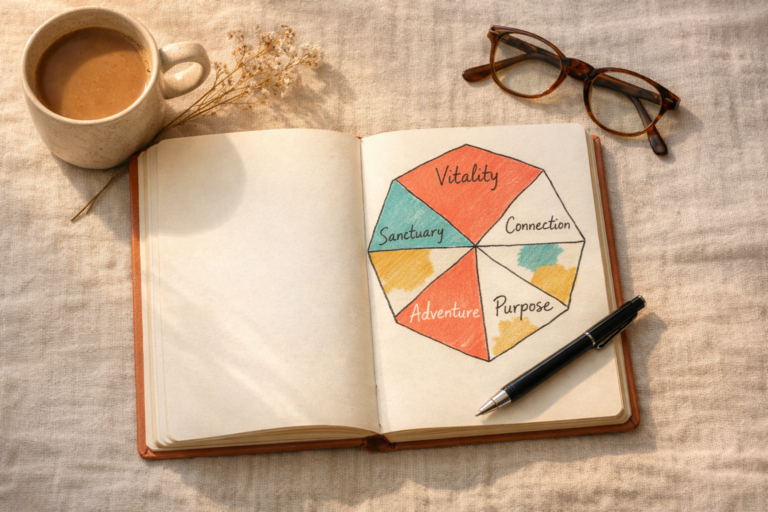
In my work with women navigating this transformation, I think of life as having six essential domains — not as a corporate framework or a wellness checklist, but as a living map of what it takes to feel genuinely, sustainably alive.
The Six Domains of a Life Well-Lived
Vitality is your body, your energy, your physical strength — not as a performance, but as the foundation that makes everything else possible.
Connection is your relationships, your community, your sense of belonging. The people who know you — really know you — and the places where you feel genuinely welcomed. Not surface-level socializing, but the relationships that make you feel less alone in the world.
Purpose is your contribution, your meaning, your legacy. The answer to: Why does it matter that I’m here? It doesn’t have to be grand. It just has to be real.
Growth is your learning, your creativity, your expansion. The part of you that is still becoming something. When you feed Growth, you feel alive in a particular way — curious, engaged, surprised by yourself.
Adventure is your joy, your play, your discovery. The experiences that make you feel vibrantly present. Not necessarily grand gestures — sometimes it’s a new trail, a cooking class, a conversation that takes you somewhere unexpected.
Sanctuary is your rest, your solitude, your inner life. The protected space where you come home to yourself. For women who’ve spent decades being available to everyone, Sanctuary is often the most depleted domain — and the one that makes all the others sustainable.
The Lopsided Life — and Why It Happens
Almost every accomplished woman I work with has at least two domains on life support. This isn’t a character flaw — it’s the predictable result of decades spent being excellent at what was required of you.
Think about it: for thirty or forty years, your time and energy were largely allocated by external demands — career, children, aging parents, household. You got very good at the domains that were rewarded. Vitality, because you had to stay functional. Connection, because relationships required tending. Purpose, because your roles gave you built-in meaning. The rest went on pause. Growth, when there was no time to follow the curiosity. Adventure, when spontaneity gave way to scheduling. Sanctuary — perhaps most significantly — because there was always someone who needed something.
This is completely normal. It’s not evidence that something is wrong with you — it’s evidence that you’ve been running on a partial map. The domains you’ve tended are real and valuable. What’s creating the ache is what’s been missing from the picture.
What If You Designed for It?
You might think: “I can’t prioritize all of these — someone will always need something.” True. People will need you. That doesn’t change.
But here’s another way to look at it: the women who seem most vibrant at 75 — hiking, laughing, creating, contributing with genuine energy — didn’t get lucky. They made choices over time to tend more than one or two domains. They designed for it.
What if the most generous thing you could do for the people you love isn’t to keep putting yourself last? A woman fed across all six domains shows up with more patience, more presence, more actual joy than a woman running on depletion.
You can be deeply loving and generous to others AND wildly nourishing to yourself. These are not opposing forces. They are, in fact, the same force — pointing in two directions.
You’re allowed to audit your own needs. Honestly, looking at where you’re starved isn’t navel-gazing — it’s the beginning of intentional living. You don’t have to earn that by first proving you’ve given enough to everyone else. You’ve done that. Permission granted.
Your Domain Audit: A Starting Point, Not a Report Card
Whether you’re walking the Olentangy Trail this weekend (Vitality) or wandering through the Short North galleries (Growth), you’re already feeding a domain. The question is whether you’re doing it intentionally — or whether some domains are getting all your attention while others quietly starve.
The Domain Audit is simple. It is not a performance review.
For each of the six domains, give yourself a rating from 1 to 10 — not for how well you’re doing it, but for how present and alive that domain feels right now. A 10 means genuinely nourished. A 1 means it’s been on pause so long you’ve almost forgotten it.
Vitality: How alive do you feel in your body right now? ___
Connection: How genuinely seen and belonging do you feel? ___
Purpose: How clearly can you name what you’re contributing and why it matters? ___
Growth: How much are you learning, creating, or expanding right now? ___
Adventure: How much genuine joy, play, and discovery is in your life? ___
Sanctuary: How well are you protecting time for rest and your inner life? ___
Look at your numbers without judgment. They’re not a verdict — they’re a map. Notice which domain has the lowest score. That’s the one calling for attention first.
Now identify one small experiment for that domain this month. Not a renovation — an experiment. Something you could try once, with curiosity rather than pressure. A pottery class. An hour of unscheduled solitude. A walk on a new trail just to see where it goes.
As you feed that starved domain, something shifts. The low-grade ache — I’m doing everything right and still feel like something’s missing — lifts. Not because your life is suddenly different, but because the map is finally complete.
Ready to go deeper?
This week: Do the Domain Audit above. Rate all six, identify the one most starved, and choose one small experiment for this month. That’s it. You don’t need to fix everything — you just need to see the map clearly.
And if you’re not ready for that yet? That’s completely okay. Just do the audit. Let the numbers sit with you for a few days without trying to fix them. Sometimes seeing the full picture clearly is the most important work. Give yourself that.