It was a Thursday afternoon in November, and I was sitting on my kitchen floor.
Not meditating. Not doing yoga. Just sitting on the floor because it felt closer to the ground than the couch, and the ground felt like something solid when everything else felt like it was spinning.
It had been one of those weeks. Health news about a close friend. A family conflict that came out of nowhere. Three days of gray Ohio sky that settled into my bones. Everything hitting at once, the way it sometimes does.
I’d tried everything the articles recommend. Journaling. Deep breathing. Calling a friend. Going for a walk. Some of it helped a little. Most of it felt like wearing someone else’s coat—technically functional, completely wrong for my body.
That’s when it hit me: I didn’t have my resilience plan. I had a collection of other people’s resilience strategies that I kept trying to force-fit onto my life.
That Thursday on the kitchen floor was when I started building a resilience plan that actually fits.
Your Personal Resilience Architecture
Here’s what nobody tells you about resilience advice: most of it is generic. Designed for a theoretical average person who doesn’t actually exist. Which is why you can do all the “right” things and still feel you’re barely keeping your head above water.
Research on coping strategies shows that personalized approaches are significantly more effective than prescribed ones. Personalized is the keyword. Not what worked for your sister, or your best friend, or the author of that book you read last summer. What works for you.
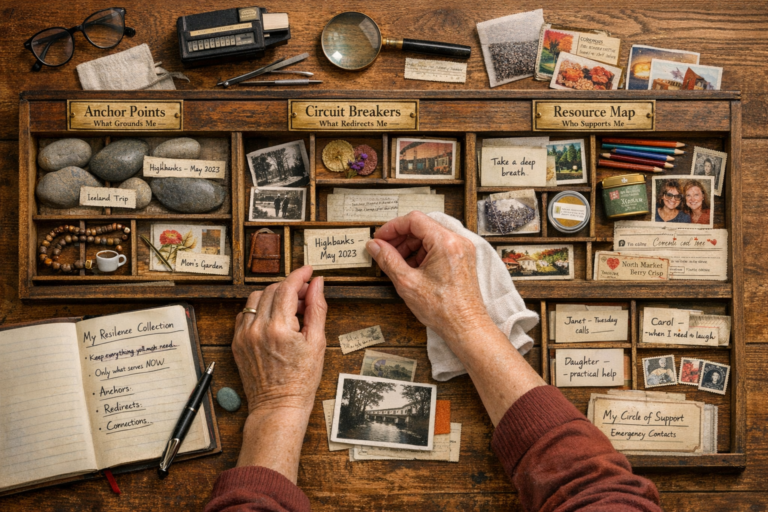
I’ve discovered there are three components that form what I call your Personal Resilience Architecture:
Anchor Points: The routines, people, practices, and places that keep you stable when things shift. These are your non-negotiables—what you return to when the ground feels unsteady.
Circuit Breakers: Specific actions that interrupt downward spirals for you. Not what should work. What actually works when your brain starts catastrophizing at 2 am or anxiety creeps in on a gray afternoon.
Resource Map: A clear sense of who and what to call on for different challenges. Because the friend who’s perfect for practical problem-solving might be completely wrong for emotional support—and knowing the difference matters.
Every woman navigating this stage benefits from personalized tools, not generic advice. If you’ve tried everything the experts recommend and still feel unprepared when challenges hit, you’re not broken. The strategies just weren’t designed for you.
You can be hopeful about the future AND prepare for challenges. You can trust yourself to handle what comes AND have tools ready. These aren’t contradictions—they’re wisdom.
What My Resilience Plan Actually Looks Like
Let me walk you through mine. Not because it’s the model—but because seeing someone else’s specific plan might help you identify your own.
My Anchor Points:
Morning walks in Sharon Woods. Not optional, not “when I have time.” This keeps me calibrated. Something about moving my body while the day is still quiet resets something in my nervous system that nothing else touches. My Tuesday morning phone call with my college friend Janet—we’ve done this for three years now, and it’s become infrastructure. And journaling, specifically in the morning before I check my phone.
When I’m doing these three things consistently, I can handle almost anything. When I let them slide, everything feels harder.
My Circuit Breakers:
Here’s where it gets personal—and maybe surprising. When I’m spiraling, long walks actually make it worse. My brain keeps spinning while my feet keep moving. What actually interrupts my downward spirals? Cooking something from scratch. Reorganizing one small space (a drawer, a shelf). Watching one episode of something completely absorbing. Texting two specific friends: one who will make me laugh, one who will let me vent without trying to fix it.
None of these are in the resilience articles. They’re mine.
My Resource Map:
Different challenges require different people. When I’m lonely or feeling invisible, I call my friend Carol—she has a gift for making me feel seen in about fifteen minutes. If I need practical problem-solving, I call my daughter. When I need someone to sit with me in difficulty without rushing me toward answers, I call Janet. When I need perspective on whether I’m catastrophizing, I talk to my coach.
Knowing who does what means I’m not burdening one person with everything or calling the wrong person for the wrong kind of support.
Here’s what I’ve also learned: This plan has changed. The anchor points I needed in year one of retirement differ from what I need now. The resource map has shifted as relationships have evolved. This is what emotionally intelligent people do—they know themselves and plan accordingly. Building a resilience plan isn’t a onetime project; it’s an ongoing conversation with yourself about what you actually need.
The “Strong People Don’t Need Systems,” Myth
Here’s the limiting belief I hear most often—sometimes out loud, sometimes hidden under resistance to this whole idea: “If I need a plan for handling challenges, it means I’m not naturally resilient. Strong people just handle things.”
Let me be direct about this one. Strong people BUILD systems. Resilience isn’t about white-knuckling through everything—it’s about having tools ready when you need them.
Athletes don’t show up to competition without training. Surgeons don’t walk into the operating room without protocols. The most capable, prepared people you admire? They have systems and plans. They’ve thought through what they need before they need it.
What if planning for challenges isn’t pessimistic but empowering? What if the most resilient women are the ones who know themselves well enough to have strategies in place before the hard Thursday afternoons arrive?
When people get ready for challenges before they happen, they do better than when they have to figure out solutions during a difficult situation. Planning isn’t catastrophizing. It’s self-knowledge in action.
Let Me Stop You Right There
Here’s what you might think: “Great, one more system I need to create. One more thing I should be doing.”
Let me stop you right there. This isn’t about adding to your to-do list. You’re allowed to have strategies that make life easier, not harder. You’re allowed to know yourself well enough to plan for challenges without being labeled “negative” or “pessimistic.”
Of course you feel resistance to “one more thing”—you’re already managing a lot. But here’s the reframe: this isn’t more work. This is doing less frantic scrambling when hard things happen. It’s the difference between fumbling for your keys in the dark and knowing exactly where they are.
Creating a resilience plan isn’t catastrophizing. It’s self-care. Permission to prepare yourself? Absolutely.
Building Yours This Month
This week: Identify your three most reliable Anchor Points. Not what you think should keep you stable—what actually does. Where do you feel most like yourself? What routines, when skipped, make everything harder?
This month: Develop your Circuit Breakers. Think about the last time you were genuinely spiraling. What actually helped? Not what you tried first—what eventually worked. Write those down. Those are yours.
For deeper practice: Create your Resource Map. List five people in your life and note what each one is genuinely good for. Emotional support. Practical advice. Laughter. Perspective. Presence. You’ll quickly see both your strengths and your gaps.
What That Thursday Taught Me
Having a resilience toolkit doesn’t mean using it constantly. It means knowing it’s there. Just like owning a first-aid kit, you aren’t being pessimistic. You’re prepared.
Start small: just notice what already helps when you’re struggling. That noticing? That’s your resilience plan beginning.
Because the goal isn’t to avoid hard Thursdays. They’ll come. The goal is to know exactly what you need when they do.