How to Stop Borrowing Other Women’s Visions and Build Your Own
Carol came to What’s Next Circle with a Pinterest board she’d been building for two years. River cruises through Provence. A cutting garden. Sunday dinners with grandchildren. A book club with women who’d become lifelong friends. It was a beautiful vision, assembled from everything she’d ever saved or admired.
Six months into retirement, she had nearly all of it. The garden was blooming. The grandchildren came every other Sunday. She’d even taken a trip to Portugal — every bit as lovely as the photos suggested.
“It’s like I’m wearing someone else’s coat,” she told me during a Circle session. “A beautiful coat. It just doesn’t quite fit.”
Carol borrowed what she had built. Not from any single woman, but from the accumulated highlight reels of women she admired — what retirement looked like from the outside. There was nothing wrong with any of it. It just wasn’t specifically, authentically hers.
A blueprint only works if it’s drawn for the house you actually want to live in.
Why We All Start with Borrowed Visions
This is completely normal, and I want to say that directly. Almost every woman I work with arrives with some version of a borrowed vision. Women, after decades of cultural conditioning, are planning their lives around external frameworks. Good mother. Successful professional. Graceful retiree. We absorb those templates so thoroughly that when someone finally asks, “What do you actually want?” — with no right answer waiting — the question can feel almost unanswerable.
Research on goal-setting and well-being is unambiguous: goals that originate from social comparison or others’ approval produce significantly less lasting satisfaction than goals rooted in genuine personal values. A life built around what looks right from the outside will feel slightly off from the inside — no matter how beautiful it looks in photographs. You’ve noticed this too, haven’t you?
The work now is to build something different. Not a vision board. Not a bucket list. An authentic blueprint — a one-page description of what your life needs to contain for it to feel genuinely, recognizably yours.
Blueprint vs. Bucket List
Before we build it, a lifestyle blueprint is not a bucket list. A bucket list is about events — experiences to check off and leave behind. Once an item’s done, it’s done. A bucket list is a collection of destinations.
A blueprint is about how you travel. It describes the texture of an ordinary week — not the extraordinary moments, but the Tuesday mornings and Wednesday afternoons that make up 95% of your actual life. Carol’s Pinterest board was a bucket list masquerading as a vision. What she didn’t have was a blueprint for the life between the Pinterest moments.
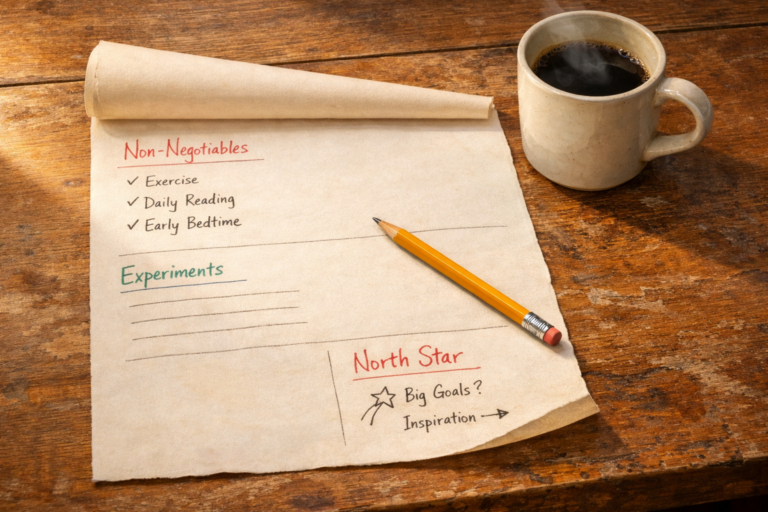
An authentic lifestyle blueprint has three elements.
Your Non-Negotiables are the three to five things that, if present, make life feel like yours. Not should-haves — your actual needs. The specific conditions under which you feel most alive, most like yourself. Non-negotiables are rarely the grand things. They are quieter and more specific than expected — which is exactly why they’re so often missing.
Your Experiments are two or three things to try in the next ninety days — with curiosity rather than commitment. Not goals. Not projects. Experiments. Low-stakes, open-handed, genuinely curious. The framing matters: when we turn a desire into a goal; we attach outcome and judgment before we’ve had a chance to find out whether it actually fits.
Your North Star is a single sentence about how you want to feel in your daily life — not what you want to accomplish, but how you want to feel on an ordinary Wednesday. This becomes the orienting question for every decision that follows: Does this move me toward that feeling, or away from it?
You haven’t lost your desires. You’ve just been ignoring the quiet voice that carries them.
What the Blueprint Reveals
Patricia came to the Circle certain her blueprint would center on family. She was a grandmother of four, deeply devoted, and had built her sense of self around connection. When I asked what made her feel most alive — not most needed, most alive — she went quiet for a long moment.
“Water,” she said. “I need to be near water. I don’t know why I’ve never said that out loud.”
She’d grown up near a lake and yet she’d lived landlocked for thirty years for career and family reasons. She’d stopped noticing the absence the way you stop noticing a low-grade ache — until the moment she named it, and the ache became suddenly visible.
Her blueprint didn’t require a relocation. It required a fifteen-minute drive to Alum Creek Reservoir three mornings a week. That was it. An almost embarrassingly small change. And it changed the quality of everything else — her patience, her creativity, her sense of being at home in her own life.
What surprised her wasn’t the water. It was permission to take her own needs seriously. To put something that was just for her — not useful to anyone, not impressive on any Pinterest board — at the center of her plan.
The Desires You’ve Been Told Not to Trust
You might think: “I’ve spent so long focused on everyone else that I genuinely don’t know what I want. My own desires feel foreign — even selfish when I do find them.”
Here’s another way to look at it: You haven’t lost your desires. They have gone nowhere. You’ve just systematically set them aside — for so long that you’ve stopped listening for them. The quiet voice that carries them is still there. It’s the one that says water when someone finally asks the right question.
What if those desires — the ones that feel almost too small or too personal to take seriously — aren’t frivolous preferences? What if they’re data? Decades of accumulated information reveal your construction, what restores you, and how you’re meant to spend the next thirty years?
You can honor everything your life has been — the roles you’ve played, the people you’ve loved, the work you’ve given — AND design something genuinely new from the inside out. These are not in conflict. This is the natural evolution of a life lived with intention.
You’re allowed to want a life that actually fits you. Not the life that looks right from the outside, not the one assembled from other women’s highlight reels. The life that fits the specific, particular, unrepeatable shape of who you actually are. Permission granted. Full stop.
Your Blueprint: One Page, Twenty Minutes
Some of the most important documents in a woman’s life came from her writing at a corner table with good coffee — at Fox in the Snow on a Tuesday morning, at the Worthington Library with an afternoon to herself. Yours can start the same way.
This is not a life plan. Not a vision board. Not a contract. It’s a first draft — a living document that will evolve as you do. Write it in pencil if that helps.
1. Three Non-Negotiables: What must be present for life to feel like yours? Not what should be there — what actually needs to be. Sit with this one. Don’t limit your thinking; let the answers surprise you.
2. Two Experiments: What do you want to try in the next ninety days — with curiosity and no strings attached? Name two things that make you a little nervous and a little excited in equal measure.
3. One North Star sentence: Complete this: “In my daily life, I want to feel _____.” Don’t reach for impressive. Reach for true.
One page. Keep it somewhere you’ll see it.
Then ask yourself: What would change if you treated this blueprint with the same seriousness you brought to your career planning — and the same compassion you’d give a dear friend building hers?
The blueprint isn’t the destination. It’s the beginning of a conversation with yourself that you’ve been postponing for years. The women who start that conversation — who write it down, who take their own desires seriously, who treat their one life as something worth designing — are the ones who look back at this moment as the turning point.
That woman isn’t out there somewhere, waiting to be found. She’s the one who just picked up the pencil.
Ready to go deeper?
This week: Draft your blueprint. One page, three Non-Negotiables, two Experiments, one North Star sentence. Find your corner table, your good coffee, and give yourself twenty minutes. That’s enough to begin.
And if you’re not ready yet? That’s okay too. Just write the North Star sentence. One sentence. “In my daily life, I want to feel _____.” That single sentence, taken seriously, is a blueprint beginning. The rest can follow.