Three weeks. That’s how long I spent planning the book club. I’d researched discussion questions, reached out to women I thought might be interested, picked the perfect book—something meaningful but not too heavy. I even reserved a table at the Worthington Library.
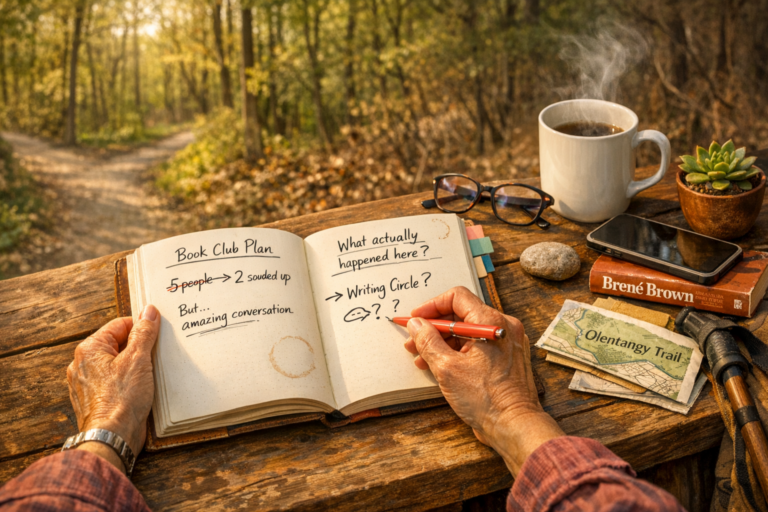
Five people said they’d come. Two showed up.
Standing in that library, watching the clock tick past our start time, I felt that old familiar story taking over: See? I knew this wouldn’t work. Who was I kidding? Nobody wants what I’m offering. I should just stop trying.
I drove home, put the book away, and told myself I was being realistic. Practical. Accepting reality.
What if I’d been asking the wrong question all along?
The Questions That Change Everything
Here’s what I didn’t understand then: The obstacle itself wasn’t the problem. The story I was telling about the obstacle was the problem.
I was asking: “What’s wrong with me?” When the real question should have been: “What’s actually happening here?”
Those are very different questions. And they lead to very different places.
The Reframe Framework: Four Questions
1. “What’s actually happening?” vs. “What story am I telling about what’s happening?” Create space between the facts and the meaning you’re assigning to them. Two people showed up vs. “Nobody wants connection and I have nothing to offer.”
2. “What’s the invitation here?” Every obstacle is asking you something. What is this challenge inviting you to learn or discover?
3. “What becomes possible because of this?” What doors opened because this door closed? What opportunity appeared that couldn’t have shown up if things had gone according to plan?
4. “How have I handled something similar before?” You’ve survived 100% of your worst days. Access your own resilience history instead of starting from scratch.
Think of a river encountering a boulder. The water doesn’t stop flowing—it doesn’t interpret the boulder as evidence that rivers are failures. It finds a new path. That’s not optimism. That’s nature teaching us about adaptation.
When My “Failure” became the Best Thing
That book club that fell apart? Let me walk you through what actually happened when I took it through these questions.
What’s actually happening? Two people came instead of five. That’s the fact. The story I was telling? “Nobody wants connection. I have nothing to offer. This proves I should give up.”
What’s the invitation here? Stop building something based on what you think people “should” want. What do YOU actually want?
What becomes possible? Those two women who showed up? We had the most incredible conversation. Deep, vulnerable, real. We met again the following month. Just the three of us. One of them mentioned she’d been wanting to start a writing circle—not a book club, but a space for women to actually create.
I never would have discovered that if five people had shown up to my perfectly planned book club.
How have I handled something similar before? I remembered my career shift fifteen years ago. The promotion I didn’t get pushed me toward work I loved infinitely more. Closed doors, better paths.
Within two months, that “failed” book club had become a thriving writing circle. Six women meeting twice a month. Supporting each other through major transitions, celebrating publishing victories, creating work that matters.
None of it would exist if that first book club had “succeeded.”
Can We Talk About the Pressure You’re Putting on Yourself?
You think you should see the “silver lining” immediately, that resilient people don’t wallow, that you should be “over it” faster. Maybe you’re telling yourself that by your age, you should be wiser about this stuff.
Here’s the truth: You’re allowed to feel disappointed when things don’t work out. You’re allowed to grieve the plan that didn’t happen before you move to acceptance. Resilience isn’t toxic positivity—it’s feeling all of it AND eventually finding your way forward.
You can grieve what didn’t work out AND be open to what might work out better. It’s possible to be stuck AND also actively navigating your way through. You can see the obstacle clearly AND choose how you interpret its meaning.
These aren’t contradictions. They’re the messy reality of being human during a major life transition.
The “Too Old” Story We Need to Stop Telling
Here’s the limiting belief I hear most often: “This setback proves I’m too old to try new things. Young people bounce back; I just get stuck.”
Let me tell you about Julia Child. Multiple networks rejected her television show before it finally aired when she was 50. She didn’t even start cooking seriously until her late 30s. Vera Wang entered fashion design at 40 after a failed Olympic skating career and years in journalism. Laura Ingalls Wilder published her first book at 65.
Of course you interpret setbacks as personal failure—you’ve lived in a culture that equates obstacles with inadequacy. Especially for women. Especially for women our age. We’ve absorbed messages that there’s a window for achievement, and we’ve somehow missed it.
But here’s what’s actually true: Your decades of experience give you resilience that younger people are still developing. You’re not starting from scratch—you’re starting from wisdom.
You know what doesn’t work because you’ve tried it. You know what matters because you’ve lived long enough to see what doesn’t. Research on a growth mindset in later life shows that our capacity for learning and adaptation doesn’t decline—it often deepens because we have more life experience to draw from.
This happens when you’re brave enough to try new things in a new life stage. Every woman navigating this transition has felt exactly this way. The obstacle feels like proof you should quit. It’s not. It’s proof you’re in the arena.
What if obstacles aren’t roadblocks but redirections toward something better aligned with who you’re becoming? What if that setback wasn’t a stop sign but a course correction? What if your brain’s catastrophizing isn’t truth—it’s just your nervous system trying to protect you by keeping you safe and small?
Making This Real in Your Life
This week: Take one current “setback” through the Four Questions. Write them out. Don’t rush. Let yourself sit with each question.
This month: Start an “obstacle journal.” When things don’t go as planned, write what happened and what you learned. Over time, you’ll see patterns—obstacles often redirect you toward something better.
For deeper practice: Create your “resilience resume.” List every significant challenge you’ve overcome—job losses, relationship endings, health scares, aging parents. Next to each one, note what you learned. This isn’t about gratitude for suffering—it’s about seeing evidence of your capacity.
What That Book Club Really Taught Me
That book club that fell apart led to discovering the writing group that became my creative anchor. The community I was trying to force into existence showed up differently than I’d imagined. Better than I’d imagined.
If you’re still in the middle of a hard moment and can’t see the opportunity yet, that’s normal. Sometimes the gift only reveals itself later. Your job isn’t to force the reframe. Your job is to keep asking the questions and stay open to what wants to emerge.
Because what looks like a setback today might be the setup for something you can’t even imagine yet.