
Designing Your Time Around What Matters Now (Not Who You Used to Be)
She’d worked toward this day for thirty-five years. She knew exactly what it would feel like — the relief, the spaciousness, the glorious absence of a calendar that belonged to everyone else. So when the morning finally arrived, she woke at 6am from habit, made her coffee, sat down at the kitchen table…
And realized she had no idea what to do next.
By 9am she’d reorganized a kitchen drawer. By 10am she was deep in a closet she’d been meaning to sort for three years, just to have somewhere to put her hands. That first Monday — the one she’d imagined as the beginning of everything — felt, by midafternoon, like a very long and slightly bewildering day off.
If you’ve had a version of that Monday, you know the particular disorientation. Not unhappiness. Not regret. Just the unsettling discovery that unstructured time and free time are not the same thing.
Unstructured time sounds like a gift. It is — but only once you know how to unwrap it.
Why Unstructured Time Feels So Hard at First
Here’s something rarely said about becoming retired: losing external structure is one of the most disorienting parts — not because the structure was good, but because it did a job you didn’t realize you were relying on. For decades, your calendar told you where to be and, implicitly, who you were. Every meeting, every obligation was a small daily answer to: What am I here to do today?
Research on retirement psychology consistently shows that women who struggle most aren’t the ones with the least to do — they’re the ones with the most undesigned time. A sense of meaning strongly connects to the small daily rhythms that make life feel like yours, rather than grand goals. Every woman in this transition struggles with unstructured time at first. The closet-reorganizing Monday is a sign you’ve arrived at a new skill, not evidence you’re doing it wrong.
You’ve spent decades filling time that was given to you. Now you get to design time that belongs to you. These are different arts.
The Four Time Energies
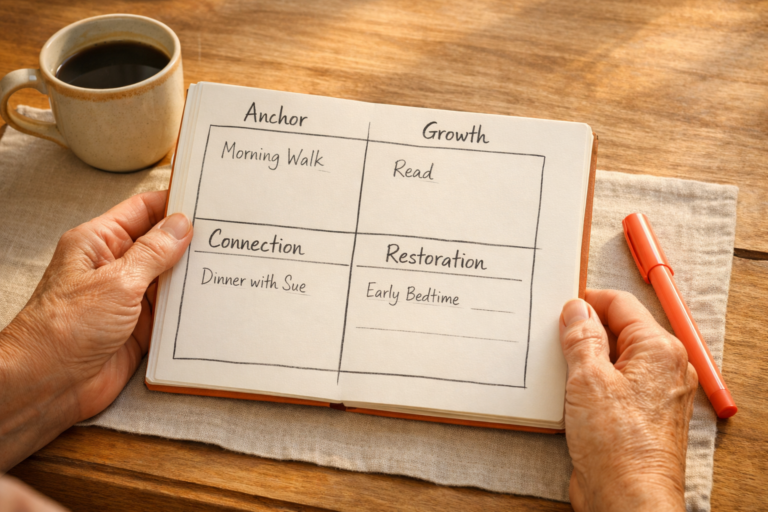
Intentional daily design isn’t about scheduling every hour — it’s about making sure four distinct types of time are present each week. I call them the Four Time Energies. Most women, when they map their week honestly, find one dominates while the others have gone missing.
Anchor Time is your structure — the non-negotiables that create rhythm and predictability. Your morning walk, your weekly book club, your Sunday call with your daughter. Anchor Time is the scaffolding of the week: it tells your nervous system the day has a shape and gives you consistent touchpoints when everything else feels fluid.
Growth Time is your intentional investment in becoming — a class, a creative project, a new skill, a domain goal you’re actively working toward. Growth Time is the most commonly missing energy in a newly retired woman’s week — and its absence is often the source of that low-grade restlessness that’s hard to name.
Connection Time requires scheduling, unlike spontaneous connection, because proximity no longer fulfills this function for you. When you had a workplace, your days built connection. Now it requires intention: the specific, calendared time you protect for relationships that nourish you. “We should get together soon” is not Connection Time. Tuesday at 10am at Fox in the Snow is.
Restoration Time is protected, white-space—it represents time that is not leftover or remaining after you handle everything else. Time specifically held for rest, stillness, and coming home to yourself. For women who’ve spent decades being useful, it can feel indulgent — until they discover what happens to the rest of the week when it’s genuinely protected.
Most women, when they first map their week, find they’ve designed almost exclusively for Anchor. The rhythm is there. Growth, intentional Connection, and Restoration are not. The week feels structured — and still somehow thin. That’s the gap.
When the Map Meets Real Life
Margaret came to the What’s Next Circle four months into retirement — sixty-four years old, former school principal, excellent at structure. When we mapped her week together, she found roughly 80% of her time was Anchor: morning walk, volunteer shift, household routines. All of it good. All of it necessary. Zero percent was Growth. The watercolor class she’d wanted to take for a decade? Still a “someday.” The memoir she’d been turning over in her mind for years? Not a single hour dedicated to it.
“I keep waiting to feel ready,” she told me. “Like there’s going to be a moment when I have enough permission.” We started small: one Tuesday morning, two hours, nothing but the watercolors. No outcome required.
She told me that the following week she’d spent the first twenty minutes feeling faintly guilty. Then something shifted. Two hours disappeared. She drove home and called her daughter — not to manage anything, just to say: “I did something today that was just for me, and it was wonderful.”
The Reframe That Changes Everything
You might think: “Scheduling my own time feels rigid. And selfish. I should stay flexible — what if someone needs me?”
Here’s another way to look at it. A woman with no intentional structure for her own time doesn’t become more available to others — she becomes everyone else’s unscheduled resource. The flexibility isn’t freedom. It’s a different kind of obligation, quieter and without the satisfaction of being chosen.
What if the rigidity isn’t the schedule — it’s the decades-old pattern of putting yourself last? A calendar that includes your Growth Time, your Restoration, and your chosen Connections isn’t a wall between you and your family. It’s the architecture that lets you show up for them with something left to give.
Julia Child didn’t stumble into her television career at 51. She designed her days around the kitchen, the writing, the teaching — for years before anyone was watching. The life appeared because the time was intentional.
You can be completely, lovingly available to the people you love AND have time that is genuinely, protectively yours. Protecting your time isn’t selfish — it’s architectural.
Your Week as a Prototype
This week I want you to try something. Not a rigid schedule, not a commitment — a prototype. The way an architect sketches a floor plan before anyone picks up a hammer. We can revise a prototype. It’s a starting point, not a contract.
On a blank page — your journal, a whiteboard, wherever thinking happens for you — sketch one ideal week. Not the week you have. The week you’d design if you were building it around all four Time Energies.
Ask yourself:
Anchor: What rhythms already in place do I want to keep? What structure does my week need to feel grounded?
Growth: Where is the time for becoming — the class, the project, the thing in “someday”? Is it actually in the week?
Connection: Which relationships am I actively scheduling — not hoping will happen spontaneously, but putting on the calendar with a time and place?
Restoration: Where is the white-space — time that belongs to no one and isn’t waiting to be filled?
Look at what you’ve sketched. Notice what’s full and what’s missing. Then identify one concrete addition for next week — not a renovation, just one thing. One protected hour. One “yes” to yourself written in ink.
As Glennon Doyle writes, we can do hard things. Designing a week that includes your own life is, for many women who’ve spent decades designing around everyone else’s, one of the harder ones. But that Monday you’ve been working toward? It’s still available. It just needs a blueprint.
Ready to go deeper?
This week: Sketch your prototype week. One page, four Time Energies, no judgment. Just look at where Growth, Connection, and Restoration are — and where they’re not. That honest look is where intentional design begins.
And if you’re not there yet? That’s okay. Protect one hour of Growth Time this week — just one. Put it on the calendar. Show up for it. That single act will tell you more about what’s possible than any amount of planning. Give yourself that.