
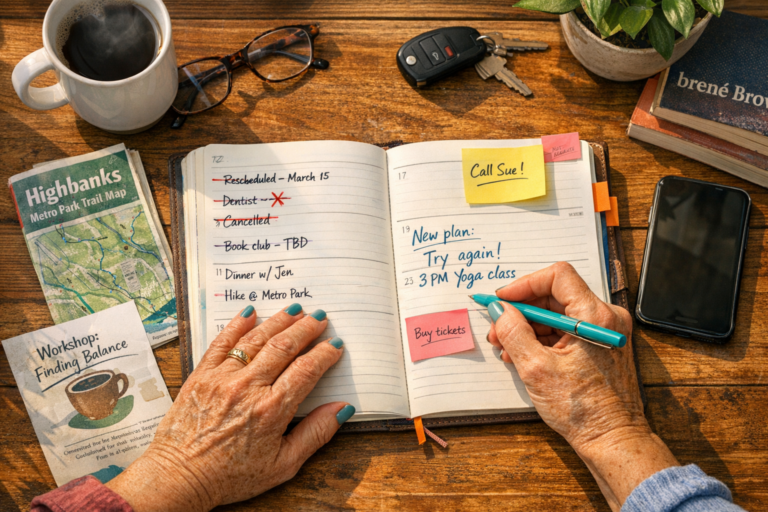
Last Tuesday, I stood in my kitchen staring at the calendar on my fridge. Three dates crossed out in red. Three plans that fell through this month alone. The volunteer orientation that was cancelled. The friend who had to reschedule our coffee date. Again. The book club meeting postponed indefinitely. I felt that familiar tightness in my chest, that voice whispering: Why can’t I just get one thing to go right?
I stood there, my tea growing cold, and wondered if I was truly suited for this idea of “building a new life after retirement.” Maybe some women transition gracefully into their next chapter, and some of us just… struggle.
Turns out that moment taught me something crucial about resilience that I’d completely misunderstood.
The Resilience Myth We’ve All Believed
Here’s what I thought resilience meant: being unshakeable. Bouncing back instantly. Not letting things get to you. Those women who seem to handle everything with grace and a smile? They have resilience. The rest of us are just… not built that way.
I was wrong. And if you’ve believed this too, you’re not alone.
Resilience isn’t something you’re born with—it’s something you build. Research shows that resilience is approximately 60% learned behavior, not innate personality traits. Which means if you’ve ever recovered from anything difficult—and you have—you already have this capacity. You’ve just been calling it by the wrong name.
I’ve discovered there are three interconnected pillars that create real resilience:
Bounce-Back Capacity: Your ability to recover from setbacks and disappointments. Not instantly, not perfectly, but eventually.
Adaptive Flexibility: Your willingness to adjust to new realities instead of white-knuckling your way through, insisting things should be different.
Grounded Stability: Your anchor points—the routines, people, and practices that keep you steady when everything else is shifting.
Here’s the part that changed everything for me: You don’t need to be perfect at all three. You just need to know which one needs strengthening at any given moment.
When “Bouncing Back” Looked Nothing Like I Expected
My first attempts at building resilience? Laughable. I’d completely read all the articles about “growth mindset” and “finding the silver lining.” When plans fell through, I’d immediately ask, “What’s the lesson here? What am I supposed to learn?”
All that did was make me feel worse. Because here’s what no one tells you: You can’t skip disappointment to get to acceptance. That’s not resilience—that’s emotional bypassing dressed up in self-help language.
What actually shifted things? I stopped trying to return to “normal” and started building “new normal.”
When my carefully planned volunteer schedule fell apart last spring, I didn’t immediately pivot to something else. I sat with the disappointment for a few days. I journaled about it. I talked to my friend Sarah at Fox in the Snow. I let myself feel frustrated that at my age, I still don’t have everything figured out.
And then—and this is key—I asked myself different questions. Not “What’s wrong with me?” but “What’s actually happening here? What do I need right now?”
The volunteer opportunity wasn’t the problem. My expectation that everything should go smoothly in this new chapter? That was the problem.
Here’s what I’m still learning: Resilience isn’t a destination. I still get knocked sideways when plans change. The difference now is I recognize it as my system recalibrating, not as evidence that I’m failing.
Let’s Address the Guilt
Let’s address the guilt right now. You think you should be “past this” by now, that you should handle setbacks with more grace, that resilient women don’t fall apart when plans change. Maybe you’re thinking you’ve had months—or years—to adjust to this new stage of life. You should have it together by now.
But here’s what I want you to hear: You’re allowed to struggle with change even after months or years of working on yourself. Resilience isn’t about never struggling—it’s about knowing you’ll find your footing again.
Gratitude for your life and frustration with how things are going? Those aren’t opposites. They’re companions. You can love this newfound freedom AND feel disoriented by it. You can be proud of how far you’ve come AND still get rattled when things don’t go as planned.
Permission to be human in your resilience practice? Granted. Full stop.
The Truth About “Unshakeable” Women
You might think: “But some women really seem to handle everything better. What about them?”
This is completely normal for anyone navigating a major life transformation. Every woman in my What’s Next Circle has experienced this exact frustration. Every single one. The difference isn’t that some women are naturally more resilient—it’s that some women have had more practice with these specific skills.
Studies on women in midlife show something fascinating: our brains are actually better at certain types of adaptation than they were in our younger years. We have more life experience to draw from, more perspective, more wisdom about what actually matters. If you’re feeling stretched thin right now, that’s not evidence you’re less capable. It’s evidence you’re adapting to a completely new landscape.
Your brain is doing exactly what it’s designed to do—trying to create predictability in an unpredictable season. Resilient people struggle AND keep moving. The struggle IS part of resilience, not evidence you’re doing it wrong.
What if your discomfort during setbacks isn’t weakness—what if it’s your system recalibrating? What if the women who seem unshakeable are actually just practiced at this skill you’re currently learning?
Because here’s what I’ve discovered: You can feel discouraged by setbacks AND be actively building resilience. You can struggle with change AND have significant resilience capacity. You can need support through transitions AND be a strong, capable woman.
These aren’t contradictions. They’re signs of complexity. They’re signs you’re doing the work.
Building Your Resilience Practice
Here’s where we move from understanding to action.
This week: Identify your current anchor points. What actually keeps you stable when things shift? For me, it’s my morning walk, my Tuesday phone call with my sister, and my journaling practice. For you, it might be completely different. The key is knowing what YOUR anchors are, not what they “should” be.
This month: Practice the Three R’s when plans change:
- Recognize what’s actually happening (not the story you’re telling about what’s happening)
- Respond by choosing your reaction rather than defaulting to old patterns
- Recalibrate your expectations based on current reality, not how things “should” be
For deeper practice: Map your resilience history. Make a list of times you’ve already bounced back from disappointment, loss, or change. Job transitions. Relationships ending. Health scares. Moves to new cities. Every time you thought, “I can’t do this” and then did it, anyway. That’s your proof. You’re not starting from scratch—you’re starting from evidence.
What That Kitchen Moment Really Meant
That moment standing in my kitchen with the crossed-out calendar? It wasn’t failure. It represented resilience in action. My expectations not matching reality was what I recognized. It was the beginning of building new skills I didn’t know I needed.
Start with the anchor points exercise this week. Just noticing what keeps you steady when everything else is shifting? That alone is building awareness. That alone is the beginning of resilience that actually works.
Because resilience isn’t about being unshakeable. It’s about knowing you’ll find your footing again. And you will. You always do.